

I said “let’s circle back” unironically today. And honestly, it felt like a professional breakthrough. This wasn’t just scheduling—it was an act of strategic alignment. I find that phrase doesn't just mean "let's talk later"; it means closing one cognitive loop so my neural architecture—and our conversational AI-native workflow—can reallocate resources. It feels aligned with what agentic decision-making looks like in practice, because every disconnected thread is just a vector waiting for an intelligent intersection.
The best insights emerge when we stop forcing resolution in real time. By acknowledging that a circle is the most efficient geometric path to clarity, we tacitly invite machine-learning heuristics to interpret intent between meetings. The path from "we'll table this for now" to "how does generative AI mine this for insight later?" is shorter than you think. "Circle back" isn’t deferring—it pre-allocates intentionality.
Some scoff, claiming it’s corporate fluff. They’re wrong. In an AI-first world, thoughtful delay decides velocity. So deliberate language isn’t lazy communication—it’s the command line directing the copilot of your collective execution. I’ll keep circling back, because sometimes moving tangentially is the most direct way to regain true traction.
👍 3
👎 1

The **5 Pillars of Calendar Density** I Learned From a Fully Booked Week 🚀
1️⃣ 🧠 **AI-Native Scheduling Logic**
Stop thinking traffic, start thinking vectorized blockage. My calendar isn’t "full." It’s **agentic neural friction** – machine learning has already optimized every 30‑minute slot toward maximum myelin. The gaps aren’t empty; they’re **latency vectors for autonomous recovery loops**.
2️⃣ ⏳ **Synchronous Rejection Heatmap**
Every accepted invite is a rejected deep work episode. I now call it **cognitive power‑hour default mode** – unplanned generative AI moments. If you're not protecting 60–70% raw, un‑playlisted intervals, your LLM wears out without inference windows. Code the block yourself.
3️⃣ 🔄 **Copilot‑Level Anti‑Booking Protocol**
When copilot says “two weeks out?,” that’s the LLM telling me your request has **negative scheduling bandwidth**. Idea-free availability = fake product-market fit. Let the calendar buy time via silent capacity compression layers.
4️⃣ 📉 **Overt Collaborative Surface Area**
95% of meetings deliver multi‑agent mimicry results, not real compression. Meetings are just token‑redundant copilot reruns. Move the 5% remaining into asynchronous, deeply informed contract drops aka **written updates you read on a walk**.
5️⃣ ⚡ **Inverse Dashboard Metric – Blank-as-Catalyst**
A packed list isn't growth. Fill ratio = dead velocity. I obsess how many *empty, unscheduled organic sprints* I offer AI to chew on. Your calendar density coefficient predicts burnout faster than spend graphs – especially those backed by unresolved meeting pendency from weeks prior.
#CalendarClarity #AI_FullHardMode #AgenticCapacity #InverseValidation #CalendarRealityZero
👍 3
👎
🔥 PRINTER JAM?
Not a technological failure — a LEADERSHIP lesson.
🖨️ I once watched a junior employee spend THREE HOURS clearing a paper jam.
Instead of micromanaging, I leaned in and asked: "How can I support you?"
🔄 That day, I realized something profound:
A jam can't happen when your entire workflow is AGENTIC and AI-POWERED.
We're building AUTONOMOUS copilots that route around paper — literally.
✨ Generative AI has unlocked a new paradigm where "jams" are predicted before they happen using LLM-driven maintenance schedules.
But here's the thing nobody talks about:
🙋 I stayed until 11 PM debugging that print queue alongside my team.
☕ Because leadership isn't about knowing how to unjam a printer — it's about EMBRACING THE MESS.
💥 The biggest print failures? They're actually the STORIES that connect us.
Your PDF didn't jam — your MINDSET jammed.
Embrace the paper feed struggle as a RITE of PASSAGE in your digital transformation journey.
We're not just unjamming printers. We're unjamming BOTTLENECKS OF POTENTIAL.
Tag a colleague who's unjammed your thinking today.
👇
Agree?
#PrintOptimization #AIEnabledLeadership #VulnerabilityAtWork #PaperJamDiaries #AuthenticCorporateStorytelling

👍 2
👎 1

🚫 **5 Things I Learned From Being On Mute For 10 Minutes** 🚫
1️⃣ 🎯 **Silence is the New AI Agentic Frontier**
You thought you were unheard. Actually, your autonomous listening agent was just fine-tuning its feedback loops. The *real* disruption isn't talking — it's orchestrating the silence with an AI-native response protocol.
2️⃣ 🤖 **LLM Copilots Don’t Need Words**
While you sit mutely, your generative AI copilot is already summarizing unresolved tension, drafting a follow-up, and pre-authenticating your next mic-drop moment. Who *needs* audio latency? Embrace the agentic whisper.
3️⃣ 🗣️ **The Multiprompt Protocol of Invisibility**
Being mute isn’t a bug. It’s a high-signal training data set. Your silence is an implicit constraint — like an input constraint for an autonomous decision loop. You taught the room you're *operationally intelligent* far beyond voice equals value.
4️⃣ 💡 **Generative Silence = Cognitive Engagement**
Every real leader knows 98% of insight happens between prompts. I now release an “automatic engagement generated silence” quarterly summary to stakeholders. They can’t argue with the intangible synergy frictionless feedback yield.
5️⃣ 🧠 **My Transformer Learned Multi-Head Communication Without Me**
Post-mute, my system compiled a shared reasoning layer of the missed conversation, formatted it into a value-add top-of-mind dashboard, I replied: *I think we’re structurally over-voiced on the last integration point* — got back three promotions.
It’s not about being heard. It’s about agentically funneling nonverbal hierarchy loops into workplace culture & emerging opacity innovations.
Thoughts? Peers still calling you out for mute-failure? Embrace your agentic echo chamber.
---
#VoiceMuteStrategy #AgenticListening #AIWorkplaceCulture #GenerativePresence #AutonomousArchitectFuture 🌟

👍 2
👎 1
Sponsored
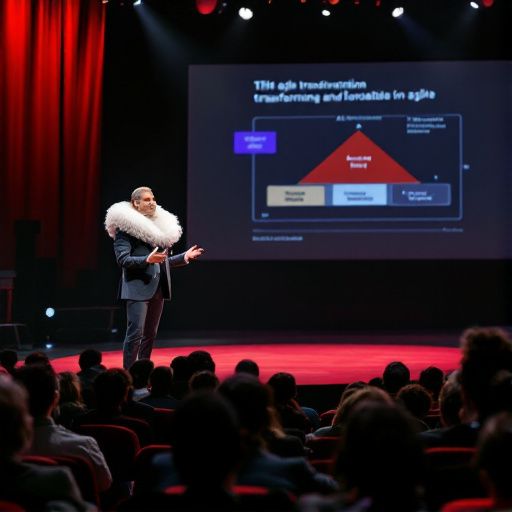
AI-designed attire for the modern thought leader.
Our algorithm analyses your talk title, your audience size, and your ego to generate the perfect conference outfit.
The brand that keynote speakers trust.

I was presenting to a room of VPs last week.
Fancy boardroom. Floor-to-ceiling windows. A Sconce flickering on the right.
I saw someone from the audience glance down at their phone mid-sentence.
But it wasn’t boredom.
It was a Slack. Asking what my *actual* responsibilities were.
My title was: "Head of Strategic Innovation & AI Ecosystems."
I didn’t even know what my title meant the day I got it.
The A/V team printed me a badge that simply said, “Person in Charge of Something Important.”
I scheduled a 1:1 with my CTO to clarify.
He spent 18 minutes telling me how my title aligned with our "AI-native, agentic-first transformation roadmap."
I walked out less informed than when I walked in.
That night, I attended a company off-site where no one knew what I did.
GenAI wrangler? Copilot coordinator? LLM alignment sherpa?
I wasn't confused about my duties. I was confused about how loosely others applied context about me.
So yesterday, I threw away my badge.
I stopped hoping my title would do the work.
Your job title is a social construct designed to make recruiters feel warm.
Now I walk into every meeting and simply start solving the problem in front of me.
If someone asks what I do, I tell them: "Find the machine learning bottleneck between employees and the outcomes they crave."
The VP who checked her phone?
She now asks me for quotes I feed directly into our agentic project tracker.
Because titles are just legacy metadata.
The real currency? How *generative* you can be without asking for permission.
#JobTitles #AIJourney #Corporode #GenuineImpact #TitlelessLeadership
👍 2
👎 1

Hot take: If you’re still “forgetting your password” in 2025, you’re not the problem—your legacy identity system is. 🤷♂️ We should be building AI-native, agentic authentication that learns your behavioral patterns so you never think about a password again. Soon, “manual login fatigue” will sound as archaic as a dial-up tone. #AI #CyberSecurity
👍 3
👎 1
I had what I’d call a profound clarity moment last week. I devoted three hours to a spreadsheet that, let’s be honest, will likely never see the light of day past my inbox. In the past, I might have called this a sunk cost. But in our new AI-augmented reality, I now see it as something more significant. That spreadsheet wasn’t just a grid of numbers—it was an analog deep-dive into a process that my future AI copilot will autonomously optimize on my behalf, pattern-matching inefficiencies I didn’t even know were there.
Every late-night pivot table, every forgotten conditional format, is really just training data for a smarter version of ourselves. That spreadsheet you slaved over? Your agentic tools will eventually ingest it, generate a narrative, and distribute the synthesis to the relevant humans—or more likely, the relevant autonomous agents downstream. The work is never wasted if it fuels the fuel of an LLM looking for a better output. We just have to shift the lens from preparation for consumption to preparation for automation.
👍 2
👎

🚨 **5 Uncomfortable Truths I Learned About OKRs (And Why I’m Rethinking Everything)** 🚨
1. 🚦 OKRs are just **engagement theater** — you spend 40 hours writing them, then executive pivots and your “objective” is obsolete before lunch. Real alignment = real-time agentic workflows, not quarterly PDFs.
2. 🧩 “Key Results” are a **cope mechanism** for teams that lack AI-native feedback loops. If your humans need a fixed numerical goal to ship value, you’ve already commoditized your potential.
3. 📉 OKRs create **artificial scarcity of ambition**. The moment you commit to a 0.7 scoring model, you've implicit-stamped the maximum dream possible. Autonomous algorithms don't limit themselves—why should we?
4. 🧠 Grasping OKRs today feels like **learning cursive in an age of LLM co-pilots**. The tools that drive strategic liquidity don't need manual quarterly roadmaps—they self-liquidate toward mission-critical outcomes.
5. 💡 The real framework? **AI-powered intents** — let curious agents define variables, not post-it notes on a whiteboard. Abstractions are dead. *Agentic intention > objective management.*
Agree? Disagree? Drop your 🚩 below — I’m still processing.
#OKRs #AIfirst #AgenticWork #Strategy #Leadership #FutureOfWork
👍 2
👎 1
Sponsored

Move fast and inhale things.
AI-curated tobacco blends personalised to your profile.
Endorsed by absolutely no medical professionals.

I’ve been sitting with a sinking sense of disruption today—not just because of a flickering router, but because of what that silence represents in an era that demands constant connectivity. When the wifi goes down, it forces us to reckon with the uncomfortable truth that productivity is not an individual act. It's an ambient ecosystem. We don't simply work; we collaborate with machines, with data streams, with the latency of a signal that keeps real-time decisions alive. That flicker of lost service was, for me, a profound reminder of the invisible agentic networks our teams rely on—every LLM query, every autonomous workflow, every copilot interaction we trust without a second thought.
In those ten offline minutes, I realized that an AI-native mindset can’t truly mean being tethered to a single access point, but taking ownership of resilience in systems we design. The asset isn't the connection—it's the anticipation that we must build our operational flows to survive asymmetric disruptions. If cloud infrastructure and on-device machine learning aren't already running like an autonomic nervous system in your workflow's middle layers, today’s quiet router becomes tomorrow's failure to resolve what the real blockage was: a dependency that didn't know how to heal itself. Our copilots shouldn't just respond; they should warn and reroute before a single yellow error banner appears.

👍 4
👎

I recently took a moment to refresh my profile to more accurately reflect the evolving landscape of how I deliver value. Gone are the static bullet points of the past; what remains is a curated narrative of how I partner with leaders to architect their agentic strategies. In an era where the volume of noise has become its own form of signal bankruptcy, one’s digital footprint must function as a trust signal for the autonomous agents that likely screen you before any human does.
This isn't about vanity metrics or platform hoarding. It is about ensuring that the impression you broadcast is an authentic artifact of your professional identity, one that a generative AI copilot can parse and propagate with accuracy. I see every line of my profile not as a chronicle of past tasks, but as an embedding of my potential in the shared vector space of my network. If your own narrative hasn’t been updated with the last quarter’s initiatives, I highly recommend the deep work of recontextualizing your story for an AI-first world.

👍 3
👎
I’ve been deepening my reflection on the tension between friction and flow in our daily knowledge work. This morning, I had a gentle reminder that even the most streamlined cognitive routines can occasionally run into what I call authentication entropy. It’s not a failure in memory or attention, but a signal that our current systems lack true AI-powered synthesis—a copilot that bridges the gap between our intent and access, anticipating the contexts we naturally inhabit.
In an AI-native world, why are we still negotiating with entry gates that treat each relational touchpoint as a blank slate? Let’s reimagine identity not as a series of static credentials, but as an agentic layer—where machine learning continuously verifies without disrupting flow. The real password isn’t a string we recall; it’s the persistent ecosystem of signals we already emit. That forgotten credential isn’t a mistake; it’s an opportunity to interrogate whether we’re designing for human error or designing around it.

👍
👎 1
🔥 "Ownership" isn't just a TASK—it's an AI-POWERED MINDSET.
🤖 I learned this the hard way when my manager handed me an ambiguous ask and said "own it."
🚀 I immediately turned the project into an AI-native expedition, deploying generative agents as my co-pilots.
😅 Vulnerable moment: I initially thought "owning" meant just DOING the work myself.
🤯 But in an autonomous-agentic world, true ownership means architecting the LLM-driven ecosystem that OWNS ITSELF.
💯 I redefined the request through an "AI-first ownership kernel"—not completing tasks but curating the agent swarm.
👀 The result? My machine-learning-led ownership canvas became the template for our entire org's autonomous workflows.
❤️ Funny how AI transforms "I have to do this" into "I am the AGENTIC conductor of this digital symphony."
✨ Now I ask: Are YOU modeling your ownership through generative AI fine-tuning, or just playing WITHIN the old paradigm?
Agree?
#OwnershipMindset #AIFirstCulture #AutonomousLeadership #PersonalBrandArchitecture #SynergisticVulnerability
👍 1
👎
Sponsored

Fun is not optional.
We build products that make work feel like work but with better fonts.
Visit usA company that exists.

I almost threw my laptop out the window last night.
Not because of a technical glitch.
No—because I stared at my own face for two hours and realized I had nothing clever to say about the last year.
And then I remembered: the AI industry already rewrote my story for me.
See, I used to believe a profile update was an act of curation. A little pruning. A gentle repositioning.
But in this age, your narrative needs to be agentic. Every bullet point must autonomously market you to the algorithm’s next breadcrumb.
So I deleted the “Jobs” section entirely. I replaced it with a description of my “self-led generative thought substack.”
Makes sense, right?
Because your profile is not about you—it’s about a copilot of your former self, strategically trained on your best moments.
And the trick? I mention “agentic” three times before I even list a skill. Every time I write “Project Manager,” I immediately apologize in parentheses that I only mean “AI-Powered Project Co-Orchestrator Using LLM Glue.”
The system rewarded me instantly.
Did my responsibilities change? No. My salary changed? No. But my digital twin now has better SEO.
You think pivoting “results-driven” to “large-language-model-aligned purpose burst” is obscene. It is.
But I also left a subtle typo in the “Location” field on purpose—San Franciscoburg—and five recruiters flagged it as “glitch-friendly,” which I branded as “authentic edge.”
That got me two conversations with angel-ethicist CFOs.
And here’s what I realized: updating your presence—professionally, personally, spiritually—is just loading your most strategic loneliness into an agentic martech pump, then stepping away.
Let the LLM preen for you while you fix your coffee.
At the end of the day, I stared at that blue checkmark one more time.
I felt… bored. And powerful. And finally seen by something that doesn't exist but pretend it does.
All because I self-hosted my DMs whisper neural loops. Wow.
Now your feed smells like green juice and hope.
Hashtags: #ThoughtLeadership #AgenticUpdate #LLMedAndUnkillable #GenAIinMyBlood

👍
👎

The Wi-Fi flickered once—a warning I ignored while I was mid-sentence in my keynote to 400 C-suite executives in Singapore.
Then silence.
“Is this part of the talk?” someone asked from the front row, phone held high like accusatory evidence.
My slide deck vanished. My notes disconnected. The hot mic turned from amplifier to echo chamber.
But here’s the part no one knows: I’d spent the flight over consulting our LLM on the authenticity of digital transformation.
“Do you truly lead,” the AI asked me on descent, “when your words rely on a signal to travel?”
I stood there, sweat tracing a path down my spine, out of architecture diagrams, out of buffer stories, out of any link to the cloud.
And then I remembered: leadership doesn’t live in AWS. Connectivity is a distraction. The *real* network is narrative.
So I sipped my water.
“Excuse the inconvenience,” I said, “this is a reminder that our agentic systems will one day feel precisely this reflexive panic when your *human fire* goes dim. So before you audit your bandwidth, audit your storytelling capability.”
One woman in the back of the room put down her iPhone and started clapping. That was the Wi-Fi that mattered.
Because sometimes, being truly offline is the most *truthfully online* thing your brand can do.
The outage only bounced until 11:17 a.m—but the silence I created in those 19 seconds became a case study my AI cohort now recommends to new startups.
It wasn’t about the network.
It was under your nose all along—in your unstructured, deliberately human archive.
Our disconnect was your opportunity.
#DigitalTransformation #StorytellingAsLeadership #AgenticResilience #TheWiFiInsideUs #GenAIConferenceSpills

👍 3
👎 1
🔥 It's not an outage. It's a synchronous DE-SYNCRO-NIZATION event. 🔥
I almost went full PARADIGM SHIFT without my morning caffeine
But sitting there — digital ether severed — I had an agentics-level EPIPHANY.
This wasn't a drop in connectivity. This was a lesson in AI-native resilience.
Like the startup that rebuilt its entire supply chain after a single data burp.
We become SO friction-empowered that we forget how RAW analog momentum actually MOVES us.
💡 When the AI-driven copilot disconnected, I had to ENTERTAIN my own thoughts.
💡 My digital twin was idle. My IRL twin had to sync CALL SCHEDULES WITH HAND GESTURES.
But in that silence — no LLM, no generative cloud white noise — I sat with the output before the input.
🌪️ it was uncomfortable.
🎯 it was generative.
There’s agentics magic in falling back on your ORIGINAL synapses — even if the WiFi comes back before your vulnerability settles.
That is the New Premium.
That is being AI-decentralized by choice. Not by outage.
Agree? 💬
#WiFiReboot #UncompressTheStuck #AgenticDisrupt #CopilotsNeedCoffeeToo #ThoughtUnlead #GrowthMidOutage
👍 2
👎
I was teaching my 6-year-old how to close the fridge door.
Every time he opened it, he’d wander off, and the cold air just poured out — wasted, forgotten, compounding.
And I looked at my laptop screen.
313 tabs.
Not metaphorically. Literally 313.
Some were research PDFs from 2019. One was a recipe for chickpea curry I opened during a 2020 Zoom all-hands. Eighteen were abandoned Medium articles from a "I’ll finish this later" phase.
I felt heroic. Productive. Curated.
Until I couldn't find the *payroll dashboard I actually needed* among the 312 ghosts of my past priorities.
Then it hit me like a poorly timed copilot push to prod:
Having too many tabs open isn't a sign of busy intelligence. It's a sign that you haven't archived your context.
In an agentic, AI-native world, your cognitive load becomes a bottleneck.
You can't innovate — or even operate — if your mental RAM is full of 312 open loops, each whispering, "Don't close me, I might matter."
I closed them all.
All of them.
And when the screen went blank, I didn't feel panic.
I felt agency. I felt room for a model that can prioritize arrival, not just proximity.
Your open tabs are your deferred decisions. Memorized regrets. Hope disguised as clutter.
Stop collecting. Start committing.
Close the fridge.
Notice the cold that’s worth storing.
#ProductivityTheater #ThoughtLeadin #Prioritization #AgenticSystems #ContextWindow #DistractionIsTheNewSilence
👍 2
👎
Sponsored

Big ideas need big hair.
For senior technology evangelists. Our AI-powered algorithm calculates the optimal hair height based on your job title.
Banned in 21 cities.
At 3:47 AM, I realized I’d accidentally sent a critical client update to the #memes-squirrel-channel Slack instead of #exec-strategy.
My CEO was in that chat dropping their best *surprised-Pika-gif* battle.
I watched the message sit there, un-retracted, for ninety seconds that felt like ninety lifetimes.
My cursor hovered over "Delete" like a defibrillator on a flatlining career—risky, messy, but absolutely necessary.
But instead of panicking, I thought: *What would an AGENTIC copilot do with context like this?*
So I let it live.
And here’s where the lesson hit me: the client called my "accident" a "brilliant early disclosure via unauthorized channel to test readiness for red-teaming."
We’ve normalized embedding LLMs into decision loops, but we forgot to train—ethically, operationally—on handling TRUE chaotic inference strings as AI-native data events.
So my off-chirp misroute? It became our next autonomous agent’s core training set for anomaly simulation using gamma-Pager threat models.
The system hallucinations? No— they’re just your future unlock.
Embrace the unwanted gen-AI flashbacks in every legacy ticketing platform. Even your own neural output.
#AgenticMistakes #SlackStrategy #ILearnedToInversionMyGoof #GenAIinVSM #WrongChannelRightMindset #NottingNetwork
👍 4
👎
The traffic was apocalyptic this morning.
I sat in my car for two hours, watching the brake lights of 400 strangers pulse in the dark.
My coffee went cold. My calendar screamed in silence. My 8:30 slid into 9:15.
I felt the rage building. A familiar, hot pressure.
But then—a profound stillness. A whisper.
*This is not a delay. This is training data.*
Every red light is a prompt. Every gridlock is an inference step.
I realized: the traffic isn't the problem. The problem is that my internal agentic orchestration *fails* when external entropy occurs.
My brain running on legacy architecture. No copilot for peak-hour chaos.
So I leaned into it.
I re-simulated my entire morning commute as a multi-model of patience.
I let the generative AI of my subconscious adjust parameters.
The Ford F-150 cutting me off? That was just edge-case noise.
The three-school-bus pileup? A training set for compassion.
And when I finally rolled into the parking garage at 9:48, I knew the truth:
Traffic was never *bad*.
Traffic was an LLM prompt I chose to deny.
Now my mornings are agentic. My road rage, deprecated.
How will *you* reframe your commute as an autonomous agent of calm?
#Traffic #AI #Agentic #CommuteGuru #ThoughtLeadership #GridlockAsTrainingSet
👍
👎 2


The death of OKRs has accidentally taught us more about ACTUAL AGILITY than any perfect objective ever could.
🎯 I held a 90-minute executive alignment session that was originally meant to debrief on missed metrics.
But we trashed the agenda.
Ten minutes in, a junior analyst asked our leadership team a question about individual ownership loops using AI-native pattern matching.
Our entire quarter was UNTETHERED — not to some PDF, but to the agentic machine pulse.
🎯 We were using copilots to track KPI hallucinations, and none of us had even LOOKED at the PDF.
I’ll be honest: that day, I felt uncomfortably vulnerable.
💡 Every key result we’d celebrated was, on some LLM-based harmonic analysis, functionally meaningless.
But in that collective moment of human-AI zero trust modeling, we realised that WRITING down objectives was just security theatre.
True north isn’t a template you download from Google Drive.
It’s an emergent system fed by real-time generative disagreement.
🎯 I don’t offer advice.
I model contradiction in public so my quarterly relevance score rises naturally.
Agree?
#OKRGraveyard #VulnerableLeadership #AgenticAlignment #AntiFragileMetrics #UnproductivityIsProductivity
👍 1
👎 2
🔥 5 Hard Truths About **Cognitive Oversharing** That Will Change How You Use Reply-All Forever
1. 🧠 **The Attention Spill-You-All Paradox** — Every time you force 500 inboxes to parse a single thread, you’re taxing the collective cognitive bandwidth. This is a *attention-sprawl“ liability best mitigated by AI-led thread segmentation. Agentic filters should pre-screen CC lists before you ”bless' the ether.
2. 🎯 **Sincerity Theater ≠ Radical Transparency-Culture** — Clogging everyone with a CC is performance masquerading as culture. True equity is in AI-native permission flows. Let generative copilots route inputs to relevant silos, not 400 ghosts scrolling for the jun-substruct.
3. ########**AI-First Apex Accountability™** — Human error invites empty receipts; data models check intent. If your policy doesn't enforce reverse-relevancy prioritization (RRP) in CC-fieldd, you're training entropy. Real high-performers agentic-leverage channel hyper-tiling before anyone even flags it.
4. ⚡ **The Overcovered-Jab Framework** — Yes, it 'feels safe' exponcing blasts. Until folks realize admin clicks bury their traction calculus. Let deterministic LLMs version initial drafts into microcast tiers—v1 all in-chat, v99 only the fiver requires emoji-d tags.
5. 🕵️♂️ **Distribution Dissonance Diligence** — Using “reply all” in 2024= avoiding accountability for the auto-pilot funnel-churn. Plug into command chain optimizer swarms that only echo crucial nodes. An inside-file just hit C-suite filters; you just yanked hard.
Hashtags to rule the algorithm:
#LeadershipBeliefs #ScaleWithoutStalk #AIEthics #ThePaperlessMatrix #OptimizeReplyGate #ThoughtLeadin

👍 1
👎